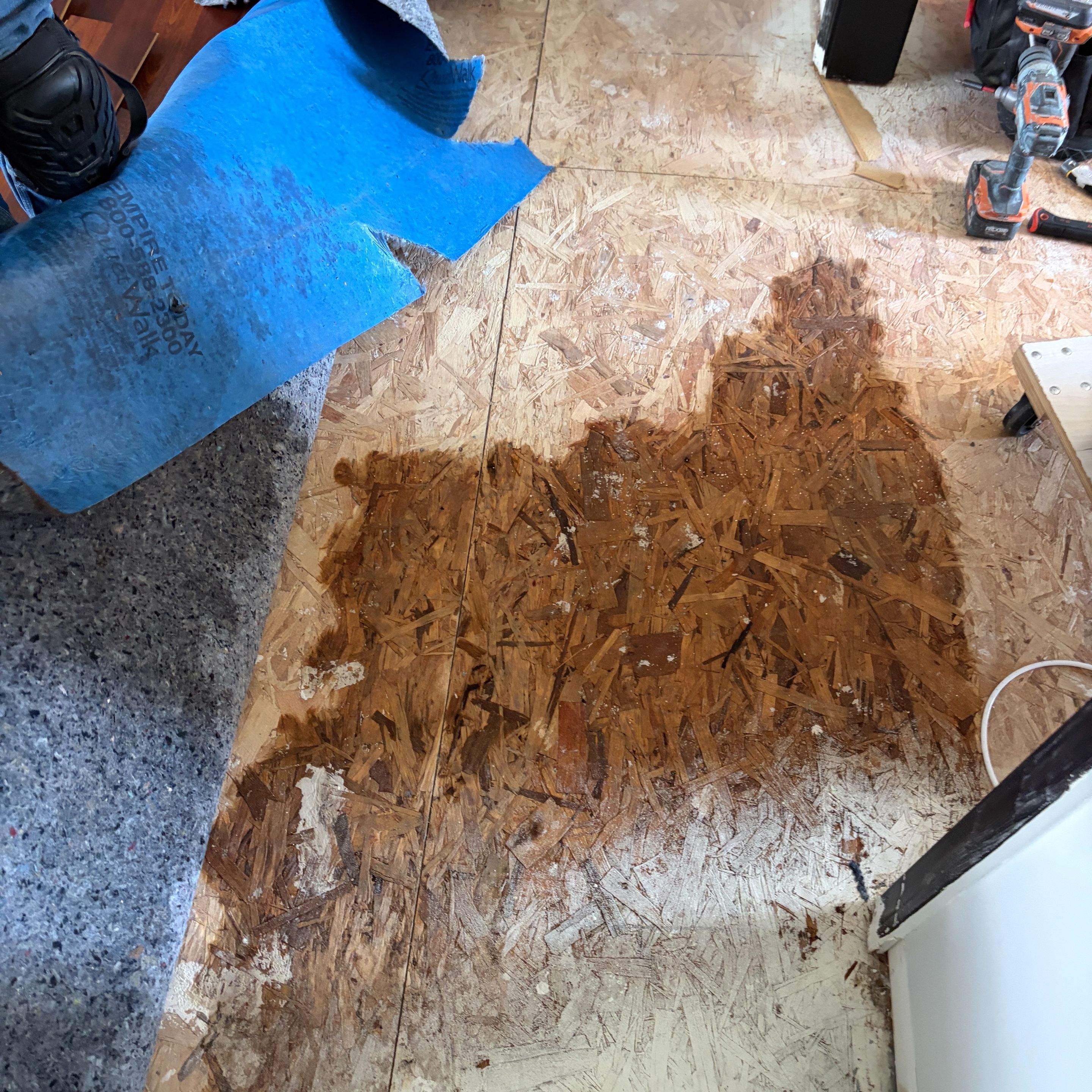
What Is Actually Happening Under Your Kitchen Floor
When a dishwasher leaks, water follows gravity and the path of least resistance. It runs down the sides of the unit, pools in the bay the dishwasher sits in, and then spreads outward along the subfloor seams. In most Seymour kitchens built in the last forty years, that subfloor is either three-quarter inch plywood or oriented strand board, both of which swell, delaminate, and lose structural strength once they pass roughly sixteen percent moisture content. Above the subfloor sits your finished flooring, which might be engineered hardwood, laminate, luxury vinyl plank, or tile over backer board. Each of these reacts differently. Laminate is the most fragile because the fiberboard core swells permanently and cannot be dried back to spec. Engineered hardwood can sometimes be saved if we catch it early and pull the wet planks for controlled drying. Tile often looks fine on top while the thinset bond beneath has already failed, which you will notice as hollow-sounding grout lines weeks later.
The cabinets are the other quiet victim. The sink base and the cabinet next to the dishwasher share the same toe kick cavity, and that cavity is usually unsealed particleboard. Once it wicks water, the bottom panel bows, the side panels lose grip on their fasteners, and the whole base starts to lean. This is why a proper assessment never stops at the visible flooring. We pull the kickplate, take moisture readings on the cabinet bases, the subfloor, the drywall behind the dishwasher, and often the back wall of the sink cabinet too. In homes with a slab foundation, water can also track sideways along the vapor barrier and surface a surprising distance away, sometimes under a pantry or in the dining room transition. In homes over a crawlspace or basement, gravity takes over and you may find the first real evidence of the leak on a ceiling tile or floor joist below, long after the upstairs floor has started cupping.
The Repair Process We Use in Seymour Homes
Restoration on a dishwasher leak follows the same IICRC S500 framework we use on any clean-water loss, but with a kitchen-specific twist. First, we stop the source, which usually means shutting the angle stop under the sink and pulling the unit forward on its leveling feet to expose the bay. Then we extract any standing water with a weighted extractor that pulls trapped moisture from beneath the flooring layers, not just off the surface. If the leak has been ongoing for more than seventy-two hours, the water is technically a Category 2 loss under IICRC guidelines because of bacterial growth from food residue and detergent, and the affected porous materials usually need to come out rather than be dried in place. That is an honest conversation we have with homeowners up front, because trying to dry contaminated materials in place is how mold problems start six weeks later.
Drying happens with low-grain refrigerant dehumidifiers and air movers placed to create a controlled airflow loop across the wet substrate. For a typical Seymour kitchen with a contained dishwasher leak, we are usually on site monitoring for three to five days. We document moisture content twice daily so there is a defensible record if you file a claim. We also use thermal imaging on the second visit to confirm there are no cold spots hiding behind the toe kick or under cabinet returns, since those pockets dry slowest and are the most common source of callback complaints months later. If you want a deeper look at how this monitoring works on similar losses, our breakdown of water extraction and standing water removal walks through the equipment and timelines in detail.
Subfloor, Cabinet, and Finished Floor Repair
Once everything reads dry, the rebuild starts. If the subfloor swelled more than a quarter inch or shows delamination, we cut out the affected section and sister in new plywood matched to the original thickness. Cabinet bases that are bowed or crumbling get replaced at the toe kick, and in some cases we can save the cabinet box by replacing just the bottom panel and the affected side. Finished flooring is the most variable line item. Tile in a small footprint might run a few hundred dollars to patch if you have spare pieces. Engineered hardwood typically runs eight to fourteen dollars per square foot installed in central Indiana. Luxury vinyl plank often comes in between five and nine dollars per square foot. Laminate almost always gets fully replaced in the affected room because matching discontinued patterns is nearly impossible.
All in, a contained dishwasher leak repair in Seymour usually lands somewhere between fifteen hundred and seven thousand dollars depending on how far the water traveled and what flooring you have. If the leak migrated into an adjacent room or down into a finished basement, the number climbs, and at that point you are looking at a larger water damage restoration project. Most homeowners insurance policies cover sudden and accidental appliance leaks, though slow long-term leaks are often excluded, which is why documentation from day one matters. The distinction your adjuster will look for is whether the failure was a discrete event, like a supply line burst or a pump gasket that gave way, versus a seeping connection that has been weeping for months and shows staining or mineral buildup. We provide a written scope, moisture logs, and photo documentation that adjusters in this region are familiar with, and we are happy to coordinate directly with your carrier so you are not stuck translating restoration jargon. If you want to understand how those costs typically break down line by line, our complete price breakdown for water damage restoration is a useful reference before you call your carrier.
What You Should Do Right Now
Shut off the water supply to the dishwasher at the angle stop under the sink. Pull the kickplate and lay towels in the bay to soak up what you can reach. Do not run the dishwasher again, even to drain it. Move any food, small appliances, and rugs out of the splash zone. Open the cabinet doors next to the unit to let air circulate. If you can see standing water beyond the immediate footprint, or if the floor feels spongy more than a foot away from the dishwasher, the damage is almost certainly bigger than what is visible. Take phone photos of every surface before you start cleaning, including the inside of the dishwasher bay, the underside of the kickplate, and any discoloration on the cabinet bases, since those images become the backbone of your insurance claim. That is the point to bring in a certified team rather than wait, because every additional hour the subfloor stays saturated narrows the list of materials we can save and pushes the project closer to a full tear-out.